“How to Increase Your Customer Base with 4 Handy Checklists” is part of our “Four Quadrants for High Growth Quick Start Guide”. To access the full series click here
Quadrant 1: Increase Customer Base
Overall Goal: Increase the number of your customers by 15%-20% per year
Four Quadrants- Quadrant 1
Quadrant 1 Sales is what most companies think of when they talk about revenue growth—increasing your customer base numbers. In fact, many of the companies we work with invest so much time, effort, and money into Quadrant 1 that they neglect Quadrants 2 and 3.
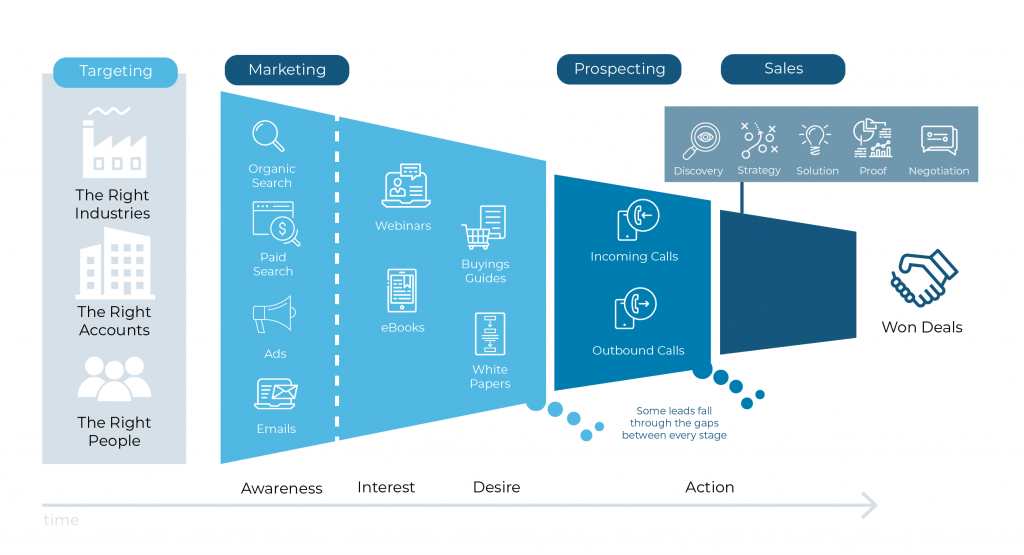
At the same time, most of these companies do not use the most critical strategy for farming in Quadrant 3: Four Funnel Framework. This is the most important strategy for winning new customers because it ensures tight integration of Sales and Marketing efforts. We will discuss the Four Funnels Framework in more detail in the next section.
Below you will find a Best Practices checklist for optimizing high growth within Quadrant 3 for Marketing, Sales, Customer Service, and Innovation.
Marketing Checklist
GOAL: Deliver the necessary number of Marketing Qualified Leads.
KEY OPTIMIZATION ACTION ITEMS:
Define the marketing content (assets) necessary to drive prospects through the various levels of interest: awareness, understanding, acceptance, preference, and conviction. The marketing assets must deliver the first three stages to generate Marketing Qualified Leads (MQLs)
Build the automation that scores the activities of very early prospects and provides them with more marketing assets until they score high enough to be MQLs ready for handoff to the Tele-prospecting team
Sales Checklist
GOAL: Increase the number of customers by 15-20% per year.
KEY OPTIMIZATION ACTION ITEMS:
Define the qualification criteria that makes a Sales Qualified Lead (SQL).
Develop the qualification and SQL acceptance process and build it into the Sales Operations and Sales Automation system.
Automate the handoff and notification process so that Sales immediately follows up on SQLs.
Build the right compensation plan that rewards progress through the Sales Cycle so that deals do not get stalled in the middle.
Build the right comp plan that rewards hunters for getting even small deals in key accounts that have significant upside potential.
Customer Support Checklist
GOAL: Convert new customers to happy and fully satisfied ones within the first 2-3 weeks.
KEY OPTIMIZATION ACTION ITEMS
Design the new customer onboarding process to be as quick and as painless as possible.
Develop a scorecard that identifies the components of onboarding a new customer and rates the new customer onboarding team along each component.
Map the components of the scorecard into the customer support system and processes so that agents can do their work with a high level of efficiency and accuracy.
Innovation Checklist
GOAL: Make your products easy to learn, use, and support in order to free up scarce resources for new products.
KEY OPTIMIZATION ACTION ITEMS
Review your current products and determine how they can be centralized, standardized, componentized, and optimized so that they are easy to sell, support, and use.
The Four Funnels Framework is a systematic methodology for generating high-quality B2B leads that deliver predictable revenue. This framework helps to overcome the “missing link” that sometimes develops between a company’s marketing and sales functions. Businesses can bridge this gap by implementing the following four funnels.
SOMAmetrics Four Funnels Framework
Funnel 1: Build Awareness
In order to sell to buyers, companies must first build awareness with their target market. The constant noise and crowding of increased market flooding creates buyers who are habituated to tuning out. Due to this, it takes nearly 16 distinct touches to sway prospective buyers to purchase; and this number only continues to rise.
Regardless of this tune out, businesses must still sell. To do so, they must first generate attention from prospective buyers. Buyers cannot purchase what they do not know exists. The most effective way to generate attention is by generating and publishing genuine marketing content. B2B sellers need to display knowledge of the pains and problems faced by their targeted buyers. Only when buyers feel that sellers understand their troubles will they consider entering into a purchasing transaction.
The goal of Funnel 1 is to drive a high number of the target buyers to where they can find out more and deepen the engagement with the seller.
Funnel 2: Build Trust
B2B buyers have little to no care about sellers’ particular products and services. Their primary concern is how to identify and address the problems they face in their companies and industries. To capture potential clients, B2B sellers must demonstrate care and understanding by freely providing the information required by prospects to solve their concerns and complications.
While such actions may appear to be giving away something for little to no return, providing this information establishes trust in the vendor. Trust generates quality leads that are more likely to transition into loyal clients.
The goal of the second funnel in the Four Funnels Framework is to feed the pipeline for Funnel 3—where Business Development Reps (BDRs) call those that have shown marketing engagement, qualify these, and pass on to Sales.
Funnel 3: Qualify
Until this point, seller engagement with buyers has primarily occurred electronically through the sellers’ websites, social media, and email campaigns. Now that contact information has been exchanged, it is time to qualify the potential buyer to determine if they are ready for engagement with Sales.
The object of this third funnel is to create a sales pipeline for the fourth funnel. In order to achieve this, sellers must ensure that the first point of in-person contact is done a professional, senior-level staff.
Many sellers have the mistaken notion that this is “telemarketing” and believe this is an entry-level job. Nothing can be further from the truth.
The task here is to interrupt a busy senior level buyer and in a matter of 20 seconds intrigue her enough to agree to a longer call or meeting at a later time. Most of the time, this requires not only knowledge of the subject matter and industry of the prospective buyer, but also an ability to know when to push and not, when to chat and when to get down to the point, all in a matter of seconds and over the phone. This is a task for an experienced Business Development Rep (BDR).
If the buyer agrees to talk for a bit, the BDR’s job is to make sure this buyer is qualified and then set an appointment with a sales rep as soon as possible.
A predictable revenue stream depends on two qualities of the Sales Pipeline:
High Quality leads that close at a higher rate and close faster
Sufficient number of HQLs to meet the company’s new revenue targets
Funnel 3 is responsible for achieving these objectives.
Funnel 4: Engage
With BDRs focusing on keeping the sales team’s pipeline full, sales reps can now focus on their primary role— deeply understanding the buyer’s world and building a partnership in solving the buyer’s issues, leading towards a successful close of the opportunity.
This is the primary function of salespeople—to work closely with motivated potential buyers and place their full attention on solving the issues of the buyer. Holding them responsible for both Funnels 3 and 4, while it may seem reasonable, is actually counterproductive.
In fact, a survey of sales professionals by Sales Insights showed that they spend over 26% of their time on average trying to generate a qualified lead. This is clearly a demanding task and takes a great deal of time away from a sales rep primary role.
Once a healthy sales pipeline and a quality sales lead has been established, the sales team can focus on continuing to qualify prospects while integrating them into the buying cycle.
The Four Funnels Framework provides a methodology for consistently achieving predictable revenues by generating High Quality Leads through a process that integrates marketing, prospecting, and sales. This integration removes duplication and waste, significantly lowering the total cost new customer acquisition.
“How to Develop New Business and Break Into New Industry Sectors” is part of our “Four Quadrants for High Growth Quick Start Guide”. To access the full series click here
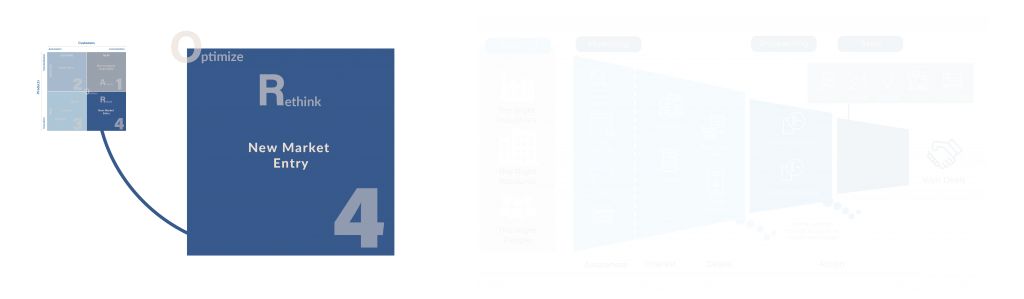
Quadrant 4: Develop New Business Outside your Industry
Overall Goal: Find a new customer type for each new product every two years, thereby increasing sales by product by another 10%-20% every two years.
Four Quadrants – Quadrant 4
By now, it may be apparent that the first three quadrants are very similar to each other. Quadrants 2 and 3 are closely related since they consist of your existing customers, and Quadrant 1 addresses the same industry as your existing customers.
Quadrant 4, however, is different. It consists of non-customers from different industry sectors than those you normally market to. It is actually an exercise in new business development.
The right approach to developing Quadrant 4 is to follow Geoffrey Moore’s advice in Crossing the Chasm and first establish a beachhead. Assemble a team of your best people to target a few selected accounts that will generate key wins for you within the new industry, allowing you to establish credibility early on. Your team members should be highly entrepreneurial and have a very strong “whatever it takes’’ attitude to winning these new customer types in an industry that no one in your company is familiar with.
In Quadrant 4, your objective to sell a product you first developed for a different market segment, with some modification and customization. You have some idea of what that customization might look like, but in truth you won’t really know until you are trying to make your first sale in that segment. This is more like a custom project, which is why you need a team that is highly entrepreneurial— capable of building something from the ground up and finding solutions for problems that you have never really addressed before.
Below you will find a Best Practices checklist for optimizing high growth within Quadrant 4 for Marketing, Sales, Customer Service, and Innovation.
Marketing Checklist
GOAL
Identify other market segments similar enough to your current market segment so you will be able to leverage many of the capabilities you already have.
KEY OPTIMIZATION ACTION ITEMS
Set up a Market Strategy team that explores applications of your current products in solving problems outside your current market.
Build a disciplined market segment analysis approach to identify the best opportunities.
Sales Checklist
GOAL
Find the early adopters and key accounts in the new market segment
KEY OPTIMIZATION ACTION ITEMS
Set up a New Business Development unit charged with finding the right entry points within the selected potential growth area.
Define the compensation plan for rewarding success.
Customer Support Checklist
GOAL
Do everything necessary to create highly satisfied and referenceable customers.
KEY OPTIMIZATION ACTION ITEMS
Set up a “Special Accounts” team whose priority is to do whatever it takes to make these early adopters highly successful with your products.
Innovation Checklist
GOAL
Make it easy to custom fit your products to new market needs within 90 days.
KEY OPTIMIZATION ACTION ITEMS
Create a platform for your products that enables you to customize and support various versions of your products.
Rapidly complete Proof of Concept (POC) projects.
Rapidly convert approved POC into stable products.
In our work with clients, we have identified three fundamental reasons why companies have missed revenue targets
Not enough opportunities in the sales pipeline to start with
Not enough of these opportunities are closing
And the ones that close take too long to close
Fixing these issues can have very significant consequences on revenues.
Improving pipeline provides directly proportional results. A 100% increase in Sales pipeline will result in a 100% increase in new sales, provided the quality of the incremental pipeline increase is comparable. In many cases, companies can grow their sales pipeline by two to five times by utilizing dedicated Business Development Reps (read Case Study).
Improving closing ratios, however, can have more than a one-to-one impact on incremental sales and reaching revenue targets. It depends on what the delta (the difference between the old and the new closing ratio) is compared to the old closing ratio. For example, if the old closing ratio used to be 15% and this was improved to 20%, then this alone will increase new sales by 33%. The same 5% improvement when going from 20% to 25% will produce only a 25% increase in new sales—which is still a substantial increase.
Similarly, reducing sales cycles can have a dramatic impact on new Sales. The analysis of the effect is a bit more complicated and we discuss some of the consequenceshere. However, briefly stated, reducing the time it takes to close deals makes revenues more predictable. This, in turn, enables a company to invest aggressively with more confidence in areas that impact its growth and profitability. Which only improves pipeline development, closing ratios, and sales cycles–creating a virtuous cycle.
In this article, we first define the problem and its causes. We then recommend some solutions we have seen work for other clients.
Insufficient Size of Sales Pipeline
Typically, when a company’s sales pipeline is shallow, it is primarily because it is relying on its Sales organization to build the pipeline, rather than on Marketing.
Ideally, two thirds of a company’s sales pipeline should come from leads generated by Marketing Operations, either through outbound campaigns or from inbound leads.
However, in many of the companies that miss their revenue targets, the opposite is true. Far too few leads come from Marketing, and sales reps are expected to prospect and build their own sales pipelines.
While the issue of Insufficient Sales Pipeline is primarily about quantity of leads, the problem of low closing ratio is one of poor quality leads. The issue is that “leads” that sales reps are working on are not yet well qualified.
These leads may be unqualified for one or more of the following reasons:
The prospect doesn’t have a compelling need.
The prospect has a compelling need, but there are too many show stoppers to make it work for the prospect
The likelihood that these kinds of prospects will become customers is very low. So why would Sales work on these?
There are a number of reasons why Sales take on leads that are not ready:
Marketing campaigns are probably not focused enough
Marketing is passing on to sales any “Lead” without first qualifying these
Because sales rep don’t have sufficient sales pipeline, they tend to be apprehensive about letting go of even unqualified leads
This is a highly unproductive use of expensive sales resources. Yet, we see it happening far too often.
Prolonged Sales Cycle
In many ways, this is a variant of the previous problem. Eventually, a lead may closes, but it takes far too long. The reasons are the same as for those that don’t close at all:
Not enough ROI for the prospect to move her along quickly
Too many things that have to be overcome on the company side before a prospect agrees to sign
Working with a prospect that has no decision making authority
Working with a decision maker that doesn’t have a budget this year
Any of these reasons can cause a stall and cause companies to miss their revenue targets. In the meantime, sales reps continue to hang on this deal thinking it will close next month, and if not then, the month after… The close date on these deals keeps shifting forward—from one quarter to the next. Each quarter’s forecast is missed.
As in the case of low closing ratio, the problem of prolonged sales cycle is a quality problem.
Focus on the prospects that have the most compelling reason to buy.
Refine your message to make your case quickly and clearly to them
Educate and empower them with information so they know they are working with a company that understands their pain and potentially has a solution for their pain.
Contact them at the right time so they welcome your calling them
Have a Business Development Rep (BDRs) call, qualify to make sure he or she is talking to the right person and schedule time with one of your reps.
Fixing Low Closing Ratios to Hit Revenue Targets
If a sales rep’s pipeline is filled with good quality leads, she is not going to be apprehensive about letting go the ones that are not likely to close. And because she lets those go, she will give her full attention to those that have a high probability of closing, which only increases the odds that these will close.
The solution, therefore, is to keep the sales rep’s pipeline 80% or more full at any given time. For example, if the ideal closing ration is one out of three, and a rep must close 20 deals a year to make her number, she needs about 60 high quality deals in her pipeline. At least 80% of these should come from Four Funnels operations (she can make the remainder through referrals and her own prospecting).
The key point here is to generate the necessary number of Marketing Qualified Leads (MQs) first. However, these should be well qualified before passing on to the sales team.
Fixing Prolonged Sales Cycles
By definition, leads that have a high probability of closing are the ones most motivated to solve their problem in the short term. This addresses the final problem of prolonged sales cycles. Motivated buyers have a timeline they need to keep and communicate that clearly. Whether they buy from you or your competitor, they will have arrived at a decision by then. There is no stalling.
The fix to long sales cycles is to improve the quality of the pipeline. The sales pipeline should only consist of highly motivated prospects with decision-making authority. The best practices for fixing this quality problem is to use a Four Funnels Methodology that enables you to control what’s in the sales pipeline.
While Sales reps are more than capable of qualifying prospects, they rarely do it since it is hard to connect with busy decision makers. It requires a great deal of dials to reach even decision makers that want to talk to a vendor. A BDR can make 80-100 dials a day and is far more likely to catch a prospect and make the appointment.
The conclusion seems to point to focus. First, focus on the right prospects. Then, focus the right skills on the right job. Let Marketing take care of the harvesting, let BDRs qualify and find the nuggets. And let your sales reps focus on closing the most motivated prospects. This is the Four Funnels Framework at work.
A fundamental shift is occurring in Business-to-Business (B2B) sales as prospecting and sales results seem to be taking a turn for the worse. Lead conversion rates are lower, sales cycles are longer, and closing ratios are not what they used to be. We hear many Sales and Marketing executives complain that “solution selling” and other sales methodologies are no longer as effective as they once were. We also hear that sales reps are losing control of the sales process, and that prospects just aren’t picking up their phones.
The problems our customers are facing can all be traced to the shift in control over the flow of information from sellers to buyers.
In past decades, sales representatives were conduits of highly valuable information for prospective buyers. They might open a sales call by saying, “…if you are anything like my typical customers, you probably have these challenges that are costing you a great deal of money. We have been very successful at solving those kinds of problems, and I would like to share with you how we do that.”
Twenty years ago, that opening was pretty effective. Aside from spending the time and money to attend conferences, buyers had limited ways of accessing information, insights, or new ideas on how to solve their latest problems. Speaking with a highly informed consultative sales rep was critical to finding viable solutions to their challenges.
Today, we have a different story. We have a digital generation of decision makers who prefer to guide their decision-making with digitally available information. In other words, they don’t want to talk to your sales rep until they are reasonably certain that they won’t waste their time doing so.
What B2Bs can learn from B2Cs
Business to Consumer (B2C) companies have always relied on marketing to draw potential customers to where they distribute their products or services—either a brick-and-mortar store front, or an online ecommerce site.
They live or die by their marketing strength, which means that they intimately understand their customers—their issues, worries, preferences, etc. They also know how to cut through all the noise and grab the attention of their prospects, as well as how to convert that attention into a sale at a consistently high level.
B2B companies, on the other hand, have always relied on their army of sales reps to get business. Consequently, once their sales reps started having trouble accessing prospects as well as they had in the past, sales began to suffer.
This problem manifests in many ways, but a key ramification is the huge difference in sales performance between the top and bottom sales performers. In some cases, we have seen a five- fold or more difference. This tells us that the top sales performers have figured out how to gain access to the right prospects, even in the absence of help from marketing, while the bottom performers are left floundering helplessly.
Continuing to believe that it is the sales rep’s job to gain access to prospects and leaving the entirety of the task to Sales would be missing the point. Just like you wouldn’t expect a waiter to first cook the food he serves you, you shouldn’t expect your sales team to do the marketing work of getting the prospect’s attention. This paper discusses how Marketing, Prospecting, and Sales have to work together to deliver predictable revenue, quarter after quarter.
First, let’s take a look at why B2B sales is struggling in the age of digital decision makers.
What B2Bs Sales looks like when it doesn’t work
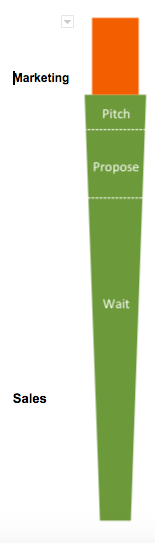
Below is a typical scenario of how marketing and sales function in companies that struggle to consistently meet their revenue objectives. Essentially, Marketing and Sales have little or no relationship and actually resent and blame each other for missed revenue targets.
Problem 1: Marketing is not held responsible for generating leads.
While the Marketing team works very hard every day, it does not have a clear mission or mandate. Lead Generation is just one of its many responsibilities, not its priority. Because it does not focus on lead generation, it typically hands over all of the contacts in its marketing program for Sales to sort out.
Problem 2: There is no well-defined, tested, and proven sales methodology that members of the sales team follow. Each sells his or her own way, with little data captured in any system. Most of the information regarding sales is typically found in the rep’s email inbox, hard-drive, or mobile phone. Management is forced to rely on verbal reports and to hope for the best.
Because they have a skinny pipeline, sales reps that do get a meeting immediately launch into their pitch rather than properly qualifying the prospect first.
They jump too early into providing a proposal for a prospect that is not very engaged, and then they wait and hope for the best.
In such cases, it is typical to see sales opportunities remain on the sales pipeline for a year, two years, or even longer. In fact, the quickest indicator of a lack of process is the extremely wide range in average deal size, average sales cycles, and average closing ratios.
The Exception to the Rule: On the other hand, businesses may have a top-notch sales rep that brings in a far greater proportion of the total sales than anyone else. In many cases, we have seen such a person bring as much as 50% or more of the sales in a company that had anywhere from six to eight additional sales reps.
This top-seller uses a very efficient process and methodology. However, she is typically the only one with a disciplined approach to prospecting and sales. She generally does not rely on Marketing to provide her with leads, and instead cultivates her own resources.
In some cases, we have seen such a sales rep actually employ someone to pre-qualify and set appointments for her so she can focus on moving her pipeline through closing.
The numbers for this top-notch sales rep are remarkably consistent, as the rep closes practically the same amount of business every quarter.
Every CEO wants to achieve Predictable Revenue Growth. However, companies that struggle to meet their revenue targets are often puzzled by their lack of results while continuing to engage in detrimental business practices.
Here are some of the issues that our clients have struggled with:
A team could reduce the amount of time spent on fulfilling customer orders by 40% through a simple change in workflow.
A company that generated 57% of its revenues from just 2% of its customers was devoting 80% of its sales team’s efforts toward pursuing exactly the wrong types of customers.
A company that was meeting its sales targets could not understand how cash flow was always a problem. It found out that 18% of its closed deals never converted into invoices because newly signed up customers canceled after experiencing frustration with protracted onboarding processes.
A ten person sales team that received an average of 3,000 leads per month felt that they were not receiving enough leads. An interview of the team revealed that the team was getting such low-quality leads that they had stopped even looking at them.
A sales team that was expected to meet its quarterly revenue goals with an average of 50 deals was not meeting its revenue goals even after turning in over 100 signed contracts per quarter. Despite this discrepancy, the sales team thought it was working hard and doing well.
A company that was struggling to meet its revenue objectives repeatedly claimed that the number one predictor of a closed deal was a site visit by a prospect. Yet, the company didn’t have a single program for drawing prospects to its site or in any way increasing site visits by a prospect.
A company that repeatedly told its sales team to focus 80% of their efforts in selling a new product saw no progress until they walked through the process of selling this product and found a number of roadblocks that had to be removed.
You may be thinking, “Well, those circumstances should have been easy to prevent in the first place. Our problems are more complicated than those.”
Perhaps they are. However, in each of the above cases, the company had a smart and hardworking management team in place.
So, why were these relatively straightforward issues allowed to persist for months, sometimes years, before being discovered?
One major reason is that all of the above issues were deeply entrenched within the everyday routines of company employees. Business operations had functioned smoothly that way in the past, but as the company added more products and sought different kinds of customers, or as customers themselves changed, as they often do, what used to work well no longer does.
Longtime employees of the company will find it difficult to notice these changes because what is routine tends to fade imperceptibly into the background.
That is why internal assessments conducted from an outside perspective are imperative. Outsiders are needed to ask “obvious” questions, some of which can be found here, that still manage to stump company employees.
Though it may be tempting to conduct an internal assessment yourself, internally-led assessments lack efficacy for various reasons. It could be very difficult for your Management Team to set aside a whole week for thorough internal assessments. It might be even harder for your team to stay objective and intellectually honest in asking tough questions, especially in explaining why they continue to do what they do.
Stop spending money on what is evidently not providing you with the results you expect, and get outside perspective. Arrange for thorough investigative internal assessments of your company–starting with Sales, then Marketing, then Customer Service, and finally with products. These should be completed in about a week to maximize the learning and better connect the dots.
If you seriously want to achieve Predictable Revenue Goal, you must know what is preventing you from doing that. To effectively root out the problems at hand, , you need the analytical lens of an external source to come in, interview, review, analyze, and report back to you within a week.
SOMAmetrics has the expertise to conduct a thorough assessment of your company’s systems, processes, and people. Call us at 510-206-9263 for a free initial consultation.
When we have Predictable Revenue Growth, we can set our revenue targets each year and achieve it within a narrow margin of error (no more than 5%). Not only that, we can also determine that each year’s growth rate will increase by an accelerator amount (20% for example), continually stretching our capabilities towards a high performance company.
To illustrate, let’s assume that our revenues are $10,000,000 for the year.
To attain Predictable Revenue Growth, let’s say we set our first year growth rate to 15% and decide to accelerate that rate by 20% each year, which is another way of saying we will commit to a 20% incremental improvement each year Here is what the first five years would look like:
Year 1
Year 2
Year 3
Year 4
Year 5
15.00%
18.00%
21.60%
25.92%
31.10%
$11,500,000
$13,570,000
$16,501,120
$20,778,210
$27,241,065
Five years later, we would be growing at 31% rate and our revenue per year would have grown 270% to $27.2million per year.
Let’s assume we were able to extend this through year ten. The numbers would look as follows:
Year 6
Year 7
Year 8
Year 9
Year 10
37.32%
44.79%
53.75%
64.50%
77.40%
$37,408,738
$54,164,022
$83,275,944
$136,986,642
$243,009,789
Now, a number of companies have shown growth rates even higher than this, year after year. But let’s say that growth rates cap at around 50% per year after the eighth year. The revenue growth in the tenth year is still remarkable at a whopping $182 million per year, as illustrated below:
Year 6
Year 7
Year 8
Year 9
Year 10
37.32%
44.79%
50.00%
50.00%
50.00%
$37,408,738
$54,164,022
$81,246,033
$121,869,049
$182,803,573
This is the power of Predictable Revenue Growth—it enables the transformation of a company into its true potential.
There is a reason for setting the acceleration rate, rather than just specifying a growth rate. Companies do not become great overnight. It takes a great deal of hard work and discipline, not to mention capital and talent, to grow at a high rate. The acceleration rate is the rate at which a company commits to improving its best practices, its processes and systems, its products and services, and its people. Each year provides the fundamentals for the next year while at the same time stretching a company’s capabilities further than the year before.
To be sure, setting and achieving a flat growth rate of even 15% a year is an admirable enough accomplishment. However, adding an accelerator rate on top of that 15% while at the same time setting targets for improvement over the prior year, is the difference between a good and a great company.
Setting these two numbers is only the starting point. The real question is how we will execute on these numbers, which depends on two fundamental changes that must happen. As these are the most challenging hurdles that a CEO faces, it is important to first clarify why Predictable Revenue Growth is vital to the future of a company.
Why Predictable Revenue Growth is Vital
Without Predictable Revenue Growth, a company’s future is always uncertain.
Predictable Revenue Growth is the difference between precarious survival and a sustained leadership position in the company’s chosen market space.
Companies that do not strive to achieve a predictable revenue growth (and do not know what levels of revenue they achieve by year end) are leaving their destiny in the hands of outside powers. A hiccup in the economy, a new regulatory requirement, a new competitor, or the loss of a major customer—any and all of these can happen and do happen. When they do, they can have a devastating impact on company revenues.
When companies commit to achieving Predictable Revenue Growth, they are forced to ask and answer some very fundamental questions that will enable them to improve their competitive advantage and market standing, which will in turn provide powerful protection from the adverse effects of outside threats.
Since setting Predictable Revenue Growth requires detailed planning to achieve that growth rate, the company is always prepared for the future. Instead of being a victim to the vagaries of an unpredictable future, it creates its own knowable future and makes it far more predictable.
The next section describes the process for achieving Predictable Revenue Growth and transforming into a high-performance company.
How do we Achieve Predictable Revenue Growth
Setting targets for Predictable Revenue Growth is the first important step, but how do we achieve this growth rate? What is a practical process of transformation for a company that has not yet achieved Predictable Revenue Growth?
In transitioning from non-predictable to Predictable Revenue Growth, a company essentially goes through four stages of performance changes—Internal Assessments, Optimization, Strategic Refocus, and Strategic Expansion.
Stage 1: Internal Assessment
The first step towards achieving Predictable Revenue Growth is understanding why you are not currently achieving that. You can find some useful resources here to help you get started on assessing your sales, marketing, customer service, and product innovation capabilities.
No matter what we believe, we all have more untapped resources and capabilities than we think, as very few companies systematically work to efficiently use their full potential.
Once we understand what hurdles are preventing us from achieving Predictable Revenue Growth, the next step is to focus on the low hanging fruits where we can make immediate gains, typically within the next 60 days.
Once we have taken inventory of what we do and don’t have, the process of Optimization continues to clean out what is no longer relevant, focus on what we can actually accomplish, and free up time and resources, which enables us to move to Stage 3.
Stage 3: Strategic Refocus
The next step is to examine the various market segments our company is currently pursuing and to select the one we can most likely dominate within the next 24 months. Too often, we see company websites and email communications claiming that “Company ‘X’, the leading provider of…” However, this is a self-proclaimed status rather than one awarded by the market.
What we are advocating for is true leadership demonstrated by the following elements: : near-total name recognition and market share, acquisition of key accounts for which all competitors vie, and clear leadership in revenues and profitability.
The exceptionally high rewards of focusing on a specific niche are well documented, as every leading company in any sector has achieved their status by manically focusing on one (and only one) niche market. Still, making the decision to focus on a single market niche can be incredibly daunting. For various reasons, this is the hardest step for most companies to take.
However, while we waste time hesitating over this decision, our competitors who have already chosen a single niche will outperform us in sales, profitability, and overall market leadership. Not only do these competitors produce more focused messaging that is clearer and more compelling to customers, they also have more targeted products and services that better address their clients’ needs. This focus turns each client into a great testimonial—which is far more effective at winning new customers than self-proclaimed statements of leadership.
As customers, we understand this. It makes sense to us when a vendor specializes in a narrow area and has exactly what we need. For example, if we were a healthcare company looking for an accounting system, we would want a vendor that has strong leadership in providing accounting systems to the healthcare industry.
And yet, when we are the vendors, we forget that customers want a specialist, not a generalist. Selling accounting systems in a generalized fashion would involve minimizing the differences between a healthcare and a mining company, for example, by telling both that we have exactly what they need.
We would be more successful if we start with one market segment, win a strong leadership position, and then leverage that to enter the next market segment. Utilizing that strategy would make our sales, marketing, product and support organizations more differentiated and more effective. This results in better closing ratios and shorter sales cycles, which produces high revenue and profit growth rates.
As scary as it seems to focus on only one niche, it is the strategy that works. Preparation is the key to addressing that fear of focusing on a single niche, and the company assessment we conducted in Stage 1 becomes the raw material for analyzing the best niche market for us to serve at this time. The commitment is to win a dominant position within this niche—at least 35-40% market share—within 24 months.
As counter-intuitive as it seems, the danger is typically choosing too big a segment, rather than choosing a small one. We should take care to choose a niche in which we can be the biggest fish in that pond–we don’t want to be a minnow with no power.
Once we pick our niche, we can now apply The Four Funnels Framework discipline to align marketing and sales and run our operations by the numbers.
SOMAmetrics Four Funnels Framework
Niche marketing is the necessary and sufficient condition that must satisfied to attain Predictable Revenue Growth, and knowing which niche to pick requires conducting an internal assessment.
Stage 4: Strategic Expansion
Once we successfully complete Stage 2 and have become a much more focused company, we should now be acquiring new customers at a higher speed than ever before. Sooner or later, we will reach a saturation point, as we have picked all of the ripe fruits off that tree. Whatever is left is likely not worth picking.
So, how can we continue to grow at all, much less at a higher rate than before, when there is no more fruit left to pick?
To continue with that metaphor, we grow by planting more trees, of the right kind, and by allowing sufficient time for these to mature and bear plenty of fruit. In other words, we must allow 2-3 years of strong investment in any given niche to realize strong harvest at the end.
The work in the second year of Predictable Revenue Growth is to systematically analyze potential new market segments and ask some important questions:
Where do we see market segments in which our core competency appears to address the challenges these markets face?
Which of these market segments:
Has a compelling need that we can fully address with a reasonable level of investment on our end?
Has relatively light competition?
Is well funded enough to afford our products and services?
Offers access to the decision-making team and process?
How do we verify these segments?
Which are the marquee accounts we must win to create a domino effect in that niche?
Which key partners do we need to start working with?
The work starts in the second year (even though we are still committed to a two-year single-minded focus on our current niche) because it takes time to do this work and come to a strong agreement and commitment on each subsequent niche.
In each niche, we must continue to implement The Four Funnels Framework to continually acquire new customers and remain into a dominant position.
This third phase must become an ongoing conversation within the company, year after year, so that we continuously and systematically explore new market segments we can enter. The Four Quadrants of High Growth provides some of the internal processes for efficiently moving from Stage 2 to Stage 3.
Some examples of companies that are excellent at this are Amazon and Google, which continually look for other markets that could use their core capabilities and always push the limits of their influence and capabilities in highly disciplined and targeted ways.
Hurdles to Achieving Predictable Revenue Growth
Let’s say we are convinced that Predictable Revenue Growth is vital to our company, the three implementation Stages make sense to us, and we are ready to start. What are the hurdle(s) we must overcome?
The single most difficult hurdle to overcome in order to achieve Predictable Revenue Growth is the commitment to change.
Internally, change means changing the culture of the company towards one that values and rewards performance, perhaps over loyalty and personal friendships.
Externally, it means moving away from a broad marketing and sales efforts to one that is focused on a specific niche that has been judiciously chosen after well-thought out analysis.
There are other hurdles, such as lack of capital or talent required to make the needed changes. However, any company that is able to commit to the two changes above will find a way to procure the talent and the capital needed to make the necessary changes.
Cultural Change
Every CEO knows that changing the culture of a company is the hardest thing to do. Still, no company can significantly improve its performance without making fundamental changes to the status quo.
At its core, changing the culture of the company really translates into the way things are done at the company— how power and influence works, what is rewarded and recognized, and what is not.
If some in leadership positions today lack either the willingness or capability to drive a high-growth agenda, they may need to replaced by others who can drive performance. While this may sound logical, for many CEOs–especially founder CEOs–this is the hardest part. Many in leadership positions are personal and loyal friends who have been with the company since the beginning. Removing them from positions of power and influence can be very difficult for a CEO to do.
There are many excellent books on how to manage change and transition, and the thesis seem to be consistent:
Be clear with yourself on why the company culture must change. Things must change in order to secure the future of your company, as well as the livelihoods of those who work for you. One cannot continue to do the same thing and expect a different outcome.
Communicate this need for change to everyone in the company. Everyone must clearly understand why this is critical and inevitable. Either they are on board with the change, or they need to get off the bus.
Require each manager to provide a written plan of action stating what, how, and by when they will achieve key metrics that roll up to contribute towards the determined Predictable Revenue Growth Rate. This is the first step towards creating a Performance Based Culture.
Work with each leader to agree on how he or she will be measured—what the metrics and milestones are, when they must be reached, what the rewards are for achieving them, and what the consequences are for missing them. Make sure that this is in writing and is signed by you and the responsible leader.
Each leader then would do the same for their top subordinates, who then would do the same all the way down to the individual contributor.
While “Management by Objectives” (MBO) is a well established management philosophy, many companies do not use it. A Performance Based Culture is a prerequisite to achieving Predictable Revenue Growth. Cultivation of this culture has to start at the top, but must consequently permeate every nook and cranny within the company to take hold and flourish.
Market Focus Change
The next major hurdle for a company attempting to achieve Predictable Revenue Growth on a consistent basis is to accept that such sustained and predictable growth comes from focusing on a specific niche, and NOT from casting a wide net.
As discussed above, focusing on a single niche provides a number of important benefits, including 50% or more increase in revenue growth; doubling or tripling profitability; high degree of customer satisfaction and retention; near 100% name recognition in that niche; and 50% or more market share within that niche, resulting in the ability to attract the best customers, vendors, and talents.
Although the benefits are well known and ample evidence exists to support this principle, many companies continue to fear “putting all their eggs in one basket” and prefer to go after multiple market segments at one time.
It is hard to find an example of any major company today that started without a single minded focus on solving a particular problem for a particular group of customers—Amazon did only books until it built its infrastructure and customer base that it later adopted to other products; Google did only search, which led to highly targeted advertising; Apple dominated certain profitable markets with computers, but didn’t explode into what it is today until it solved a single consumer problem—ability to carry all of your music with you on a device that is smaller than a phone. It later did the same with its iPhone. Other examples of companies that focused on only one thing and did it well include Dominos Pizza, Salesforce.com, Uber, and Southwest Airlines.
The second cultural change required is to Focus on a niche and Dominate it. Then leverage profits, name recognition, and market leadership attend in that niche to repeat the performance in the next adjacent niche. Repeat the process for continuous growth. Each niche will require at least two years, and perhaps up to five years, to fully develop. Be patient and stay on the course until you have won at least 40% of that market so you are in the top two suppliers to that market segment.
Conclusion
This article has built a case for why Predictable Revenue Growth is vital to the future of a business entity. It has also explained the necessity of setting clear growth and acceleration rate targets, committing to changing company culture to one of high performance, and committing to a niche market strategy.
SOMAmetrics helps companies achieve Predictable Revenue Growth through the application of best practices, automations, powerful analytics, and expert resources. Please contact us so we may help you achieve Predictable Revenue Growth.
A Predictable Revenue Model (PRM) enables a company to achieve 20% or more revenue growth year over year, sustainably and profitably.
Its key benefits are:
Sustainable high growth of over 20% per year
At least a 30% increase in profitability
At least a 30% increase in customer satisfaction
A Predictable Revenue Model is characterized by five traits that are necessary for delivering the above results:
Specific and purposeful focus – when focus and specificity are lacking, people tend to do what comes naturally to them. The end result is that you have people rowing in many different directions and when it feels right to them. As a result, the boat tends not to move much. When specificity and purpose are added, people know in what direction they must row, and at what speed.
A detailed yet simple Execution Plan – It is one thing to say we will grow at 20% a year. It is another thing to work that backwards so that people know what they have to do this week and next to get there. The execution plan is what ties the day-to-day efforts of everyone with the strategic focus so everyone rows in the same direction and at the specified speed.
Systems and processes that are optimized to support the plan – rowing in the same direction and speed implies tools and processes that track and enforce these. Giving people different sizes and shapes of rows will make it harder to row at the same speed and direction. Making the rows the same size and shape, adding a navigation system, having a boat that is streamlined, all these aid in getting to the destination faster and with more certainty. Tools and processes that enforce the plan are a crucial element of a high growth plan.
The right skills and reward system that execute the plan – it now becomes obvious that getting the right people and providing them with the right incentives increases the chance of rowing in the same direction, at the specified speed. You want people that have the natural inclination to do the things you want done and like to be recognized and rewarded for achieving the goals you set for them. You need smart, results-oriented people who don’t mind giving more each year, to get more than ever before.
The constant gathering and analysis of data in order to drive continuous improvement—without continually analyzing data, the only way you can grow 20% or more is if your industry grows faster than that. How many times does that happen? If you gather data and analyze it regularly, you can make continuous improvements that add up to higher productivity than your competitors. Therefore, even if you industry doesn’t grow at a high rate, your company will as it does more business relative to your competitors.
We will discuss each one of these critical components in more detail, and more importantly, how to implement them in the most practical and least resource consuming way possible.
1. Defining a Specific and Purposeful Focus
Of all the five components of a High Growth Plan, this is by far the most important and most difficult to complete. It turns out that the difficulty company Executives face is not intellectual but rather emotional. Many postpone deciding on which markets to focus on for fear of missing out on revenue potential.
Ironically, the fact that there is no focus actually slows down revenue growth rather than increasing it.
Here is a simple test you can perform to find out how true this statement is.
Who do you think makes more money, the heart or brain specialist, or the general practitioner doctor?
In the era of the PC, Microsoft was the largest software company in revenues. More importantly, it took more than 50% of all of the profits of the entire PC industry! Why, because 90% of the PC’s ran on Microsoft Windows, and nearly all of these used Microsoft Office.
Google owns 80% of the search market, which enables it to grow roughly 20% a year, generate over $700,000 in sales per employee—an incredibly high productivity rate.
Apple sells only a handful of products (laptops, desktops, tablets, and phones primarily)—yet it is either the number 1 or #2 company in the world in market capitalization, with over $100 billion in cash in the bank.
These few examples show that focus increases revenue, not shrink it. But even more critically, it has a remarkable effect on profits. Focused companies, which sell a few products to a few markets, tend to have a lower cost of doing business, higher name recognition and market share, faster sales cycles, and overall better customer satisfaction than those that sell many products in many markets.
Which company has better customer satisfaction—AT&T or Apple Computers? Which of the two do you think sells a wider selection of products to more diversified markets?
As Geoffrey Moore, the noted high-tech marketing guru and best-selling author eloquently puts it, “…you do not have to pick the optimal beachhead to be successful. You just have to win the beachhead you picked”. In other words, it is far more important to commit to the decision you made (once you pick a target segment) than it is to make the best decision in picking the right segment.
2. Building Detailed but Simple Execution Plan
Once a market segment is picked, a specific plan for dominating this market segment can be prepared. By dominating, we mean a market share of at least 35-40% of that market segment within a three-year period. That is the goal of the plan.
The next phase is to define how you will achieve the plan. Your plan has to take into account three separate but highly inter-related sets of activities to achieve the desired goal: Marketing, Sales, and Delivery.
At SOMAmetrics we advocate the use of a Four Funnel Framework to integrate Marketing and Sales to achieve the desired Revenues. To give a simple illustration, say you want to achieve $10 million in incremental revenues in 2015 and your average deal size is $50,000. That means you need to close 400 new deals.
Say, your average closing ratio is about 25%. Therefore, you will need to have about 1,600 potential deals or Sales Qualified Leads (SQLs) in your pipeline. Let’s further say that maybe 20% of all of your Marketing Qualified Leads turn into a SQL. Therefore, you will need about 8,000 MQLs delivered by your marketing department in 2015. If your closing cycle is, say four months, then these 8,000 MQLs have to be delivered by the end of August to make a difference in 2015 revenue numbers.
The above numbers now give us the Planning targets:
$10 million in new revenues
Four hundred new deals closed
One thousand six hundred opportunities (SQLs) in the sales pipeline
Eight thousand Marketing Qualified Leads from Marketing
Roughly 1.6 million marketing touches to generate the desired 8,000 MQLs
The next step is to figure out how each of these numbers will be achieved in terms of resources and support systems.
How many sales reps will be needed to close 400 deals in one year?
Where will you get the list of prospects and how big must the list size be?
What are the marketing assets you must develop to attract these prospects, and who will be developing these assets? How much time will that take?
What kind of marketing campaigns must you conduct to generate 1.6 million touches to your targeted prospects? How often must you conduct these campaigns, and how many times per prospect?
If you have to install your products, and train customers on how to use them, you have to timeline the closing of deals and see how many resources you will need to implement what your sales organization has sold.
You also have to worry about supporting customers on an ongoing basis. Your plan is to add 400 more new customers this year. How will they be supported? What is the average customer satisfaction rate you are going for? What will that entail to satisfy your customer satisfaction metric?
This is the minimum level of detail required to implement the plan.
Our experience has shown that the degree to which a plan is executed is a function of two critical factors: the level of detail of the plan, and the simplicity of the plan. These two factors, while NOT exactly being mutually exclusive, are hard to work into the same plan and strike the right balance.
3. Implementing Systems and Processes that support your Plan
The best way to manage the work of people is to create the necessary automated processes that guide their work. If we want to make sure that our people are rowing in the same direction and within the same rhythm, we need to equip them with oars that are the same size and shape.
The organizational parallel to this is to standardize the systems and processes that your people use and to encourage them to use these in a consistent way. This introduces an age-old debate about what is the right choice to make, select a system that can do pretty much everything such as SAP or Oracle, or go with a best of breed approach and integrate the systems.
Our view is always to go with the best of breed approach provided you also follow some basic rules:
Use the same rigor to select the system of choice, regardless of whether you are going with a best of breed or a monolithic system.
The total number of systems you use within your company should be the fewest possible and yet allow you to automate all of your major business processes.
Each of your systems should be well integrated with any system that already has the data this system needs to use. In other words, a cardinal rule is that data should always be entered once and used as many times and places as necessary. One crucial design decision is which system should be responsible for capturing the data in the first place, and which systems are to consume this data from that system.
In designing your systems and processes, it is wise to follow a key principle: design for version three, spec out version two, and build version one. That way, you will reap benefits right away while building critical flexibility into your system.
Take a full audit of your systems and processes at least every 12 months to verify that they are still relevant, that you have not outgrown them, and that you don’t have critical gaps in your system and processes that might prevent you from achieving your growth targets.
In our experience, we have found Salesforce.com to be a powerful, flexible, and extensible platform that can handle the requirements of pretty much all small and medium sized businesses today as well as grow with them to meet their needs of tomorrow. Because of the huge amount of applications developed to integrate and extend the core capabilities of Salesforce.com, it is the most affordable platform for running business processes for most small to medium sized businesses.
4. Getting the Right Skills and Reward Systems in Place
The next step is to think about human resources—what kind, how many, and how you compensate them. Right after the first component—deciding on which market segment to focus—this poses the greatest difficulty for most of our clients, especially those that have been in business for ten or more years. This is especially true for those that founded their companies with little or no funds, who hired help they could afford—that is to say cheaply.
In very few instances, these founders lucked out and hired moderately skilled but highly motivated people for cheap. And these extraordinary individuals put in their heart and guts to grow the company along with the founders. Ten years later, they had acquired vast knowledge and experience and are indispensable to the company.
However, the more likely scenario we have seen is that the founders hired moderately skilled and motivated people for moderate pay. Then they used the Peter Principle; promoting people to a new level based on their ability to do their current job, rather than the new one, rewards seniority by putting in place of high power and responsibility those that do not necessarily have the ability to discharge that responsibility effectively. Furthermore, these managers feel more comfortable with this level of experience and prefer to hire people they feel are less capable than them, rather than more capable.
Sooner or later, the company faces the danger of accumulating moderately capable people who give moderate performance. Newer competitors come out with better products and services, the response to which is to compete on lower price, which further deteriorates the company’s position.
It is critical to hire smart, results and growth oriented people and do everything in your power to keep them: by rewarding them well, giving them challenging assignments, and recognizing them in front of their peers when they successfully carry out their assigned tasks. It is not just money, but also growth and recognition, along with money, that is the effective reward system for smart, results and growth oriented people. They will work hard, typically 50 or 60 hours each week, to earn their reward and their recognition, and to master new skills. And in the process, will help propel your company into its next stage of its growth.
5. Constantly Analyzing Data for Continuous Improvements
Whatever is not measured does not get attention, and it will never improve. That is well known and accepted. The key to growth and improvement is to bring attention to the very few things that matter—what we call Key Performance Indicators or KPIs.
Each of the three sets of activities we mentioned—Marketing, Sales, and Customer Support—has its own set of KPI’s.
The steps are simple, but they require a high degree of rigor and diligence to actually convert into real results:
Define the KPIs (some we have mentioned above already such as number of SQLs, MQLs and touches; percentage of accepted SQL’s by sales; average sales cycle; average deal size; number of sales contacts to close a deal; revenues by employee; revenue by sales rep; sales cost as a percentage of revenue; marketing cost as a percentage of revenue; time from contract to invoice; account growth rate per year; customer satisfaction rate; and so on.
Design the monitoring process/systems—what is your system of record that can handle your processes and with reasonable ease provide the data you need?
Automate the reporting and management and review of these KPI’s so they are in everyone’s face as frequently as possible?
Set quarterly objectives on moving them a notch to the next level so they are continually improved. Can you get your managers to review data each week and set the next week’s tasks towards achieving these targets?
Work back into the plan the specific changes in systems, processes, and work activities that must happen to obtain those continual improvements.
Take Away
In this article, we discussed how a company that desires to meet its growth objectives on a sustained basis must do five things well, and must do them continually and relentlessly. It must decide to focus on a single or no more than two markets so it can act with purpose; it must develop a detailed yet simple plan; it must build the right systems and processes needed to execute the plan; it must hire smart, results and growth oriented people and reward them the right way; and it must constantly collect and analyze data so it can continuously improve towards sustained future growth.
All five are critical and must be done in the correct order. We also saw that #1 and #4 are probably the hardest to do of the five, and probably because they both require breaking away from the old culture and moving to the one.
However the real cost of not making these changes is falling into mediocrity and possibly risking the company to fail. This is why a company must target a growth rate of about 20% or more each year so it is assured continued viability and relevance in today’s and tomorrow’s market place.
The key to a healthy, viable sales funnel begins at Teleprospecting. Determine the number of Marketing Qualified Leads for each Teleprospecting team (I recommend at least 150 leads per person). Then, verify their access to these leads. Lastly, apply the Teleprospecting Best Practices recommend in my blogs.
Be sure to keep these 6 points in mind, as you establish and expand your teleprospecting team.
The Sales Funnel is King! Instill collaboration between Sales & Marketing to ensure a quality sales funnel. These departments must develop and agree on qualification criteria and other key metrics, to ensure consistent sales funnel growth. Revenue growth will cease without quality Sales Qualified Leads (SQL) and a healthy Sales Funnel.
Hire experienced staff. The Teleprospecting team is most often the first contact a prospect will contact, within a company. Therefore, it is counter-productive to assign entry-level employees to these positions. They lack experience in selling complex solutions and communicating with senior-level executives. With a history of nearly 30 years, experienced professionals are readily available to hire. This is one decision your company will not regret.
Focus Teleprospectors on one Solution. Efficiency begins to decrease as telemarketing teams become responsible to sell & learn multiple products or solutions, especially if they are complex. Focus delivers a quality sales funnel.
Develop and implement Kay Performance Indicators (KPIs), or metrics, to manage a team. Once the KPIs have been established, assign each team to create a plan that outlines a process to reach their goals. This empowers team members to carry out each task and take responsibility to meet their objectives. Managers may work alongside the Teleprospecting teams to ensure the practicality of these plans. These plans also provide a blueprint to manage activities and measure results, for the Manager, as well as the Teleprospector. (See my blog for details here).
Develop a Teleprospecting Playbook. A Teleprospecting Playbook is a set of tools that guide Teleprospectors through the qualification process for Complex Solutions. This playbook must be written and assembled by individuals with sufficient knowledge, such as expert from Product Marketing or Sales.
Build compensation plans that drive desired behavior. A satisfying compensation plan motivates Teleprospectors to excel at their duties. Create compensation plans that focus on the Sales Funnel and generate revenue growth.
These 6 points will allow you to create a strong front-end for your sales funnel. By applying these best practices, your team will produce a healthy, robust sales funnel, providing for an increase in revenue growth.
Alicia Assefa has been managing Teleprospecting and Inside Sales teams for the past 15 years. She is the author of the bestselling eBook “Teleprospecting for Executives Who Sell Complex Solutions”, which is available on Amazon here.
Many of the sales managers I have worked with at over 100 technology companies believed that having more deals in the sales funnel translated to a greater likelihood of hitting their sales goals. While they looked at the size of the sales funnel (revenue potential), they forgot to consider when the deals were put on the sales funnel. They also neglected to determine if the deals were really viable.
In general, the rule of thumb is that sales funnels should be about 3X-6X the revenue objective to ensure that revenue targets are met. Most of my clients showed me sales funnels that exceeded this range. At first glance, I thought that the Sales Managers were doing well at managing sales funnel growth, but as I browsed further, I discovered that 80-90% of the deals were over 2 years old and not viable. Week after week, these Sales Managers would review the deals, and week after week their Reps convinced them that the older deals would close at some point in the future.
The next issue that I uncovered with my clients’ sales funnels was the viability of the newer deals being added to the funnel. After the initial call, Sales Reps should be validating the quality of the lead. Questions to determine viability can vary: Has a decision maker been contacted? Is there real need and pain established? Is the prospect looking at solutions to solve these problems within a reasonable time period? Did the prospect indicate some interest but didn’t have a real need?
One of my clients believed that every prospecting onsite meeting was a true indicator that the prospect was interested in the solution. The Sales Manager required that a quote/contract be left with the prospect after every meeting. When I worked with my client, I found that the Sales Reps did a good job of “showing” the solution. However, they were ineffective at qualifying for need, interest, decision process, and timeframe. This client’s prospects were in the State and Local Government space, where prospects are more willing to meet and see presentations. My client had hundreds of deals on the sales funnel; however, he never hit his sales targets.
Finally, the last issue that I uncovered was movement of deals from the top of the funnel to the “closed” or “closed-lost” stage. Many deals were stalled in the various stages of the funnel prior to “closed” or “closed-lost” for many months or even years.
These funnel symptoms created a false impression that the client’s sales funnels were healthy and viable. These issues arise when a Sales Manager lacks a good sales methodology or has not made sure that their Reps understand the methodology. In any case, all three symptoms kept my clients from hitting their targets.
6 Steps to Cure the Sales Funnel Bloat
Even though Funnel Bloat can be deadly to a sales team’s ability to hit targets, it can, fortunately, be cured. Follow these 6 steps to continue finding leads and ensure that you don’t fall victim to Funnel Bloat:
STEP 1: Develop a sales methodology that works for your company.
Determine the following:
Who are your targets?
What pain does your solution solve?
What is an average time frame in which most deals should close?
STEP 2: Once you know these elements, figure out the number of stages most of your deals go through. Is the number of stages 5 or more? During each stage, decide what triggers must happen before the deals move to the next stage.
STEP 3: Retrain your team on the new sales methodology and make sure that they understand it.
STEP 4: Take a fine-toothed comb to your current funnel. Any deal that is older than your required time frame, whether that is 3-months, 9-months or 18-months on average, should be removed and re-qualified or put into a nurture program.
STEP 5: Build Sales Engagement tools that support the movement of each deal through the sales funnel. For example, build an ROI calculator which is easy to use and shows cost savings or build a “standard” demo that can be used by your team in a middle stage to keep prospects interested.
In the final stage, before close, send your prospect a Memorandum of Understanding. The MOU should outline an overview of the prospect’s needs/pains, how your solution can solve their problem, the outlined ROI, and the agreed price. The MOU should also include a date for when the prospect will finalize and legally sign documents and procure the product.
STEP 6: Be ruthless with any deal that is added to the funnel. Your Reps should have to justify why a deal should be added based upon your company’s sales methodology. One of my Sales VP’s used to say, “Get the bad news early.” If there isn’t really pain or necessity, then you don’t really have a deal.
After the cure has been applied, though painful, you will have a viable sales funnel. Once you have a viable sales funnel, you will probably need to ramp up your marketing efforts to get the sales funnel to a level of 3x-6x your revenue objective. Funnel bloat is deadly, so apply the cure and hit your revenue targets.
A few weeks after school started this year, my daughter informed me that she was “done with school.” Because she is a straight-A student and only a sophomore at her private Catholic high school, I was very worried and concerned. After many conversations, I found out that she wanted to have more fun and more respect from her elders. I took this information to heart and we made a plan. She is now a happier and motivated student.
I believe that motivation has to come from within. What should corporations do to ensure that their employees remain motivated day after day for years? Here are 3 steps your company can take to keep your team motivated and focused:
Survey your employees to get a sense of what gives them satisfaction and what keeps them motivated at work. These surveys should be anonymous. In the survey, ask your employees what they need from the company to feel like they are making a contribution to the company, their families and their communities. In addition, the survey should address the following:
Find out if they feel respected and appreciated by the company and the management team. Ask them to explain the ways they feel respected and appreciated. Perhaps they would like more responsibility or a greater say in how they perform their duties. Maybe the team feels disrespected by a certain manager who may need to take some classes in managing people.
Ask your employees if they believe they are working too many hours or feel compelled to work during evening and weekends to get caught up on their work.
Ask your employees if they believe they are working too many hours or feel compelled to work during evening and weekends to get caught up on their work.
Ask your employees if they believe they are working too many hours or feel compelled to work during evening and weekends to get caught up on their work.
Ask if your company has too many or too few meetings. Either of these choices can lead to a lack of productivity and motivation.
Once you have compiled the survey results, review the issues and determine how to address them in the short and long run. Create a “task-force” to brainstorm on the issues and to make recommendations for improving the situation. Be prepared to implement the recommendations in a timely manner. Create a timeline for the roll-out of these recommendations.
Share the survey results, task-force recommendations and roll-out plan with your employees to help them stay motivated.
The answers may be as simple as providing:
Employee training on subjects such as organizational skills, tool operation, or time management.
Team off-sites, a few times a year. These should be fun and engaging for your employees.
Opportunities for team members to earn bonuses or additional PTO days.
Lunch time activities such as yoga, meditation and stress management help keep employees motivated during working hours.
Some financial support for those who want to go to University or graduate school.
Companies who stay in touch with the needs of their team members are more likely to have loyal, productive and motivated employees. These are the things that success is made of.
I would love to hear how your company keeps your employees motivated. Please email me your ideas at alicia@somametrics.com. I will compile these to share in a future post.
The best coaching session that my team had was when I was the Director of Inside Sales at an educational software company. One day, out of the blue, the CEO called me to ask if he could “coach” 4 of my Inside Sales team members. He wanted me to select two top producers and two under-performing team members. His plan was to spend 1 hour with each Rep.
He did 3 things that made for a great learning experience for my team and a lasting impression for me, as a manager.
Lead by example. The CEO started each of the sessions by making phone calls. He wanted each team member to see how he approached a first call with decision makers. He didn’t let any of the prospects know that he was the CEO. He made several calls, while the Inside Rep took notes. After the first few calls, the Inside Rep was given the opportunity to make calls. Back and forth this process went, for the entire hour.
Have a goal for your session. The goal for each team member and the CEO was to generate a meeting/ further conversation with the prospect to uncover need and interest. The CEO threw down the gauntlet. Who would get the most meetings, during the hour coaching session? The CEO beat only 1 team member.
Make it “win-win”. The purpose of the coaching session was to give the CEO a better understanding of the challenges that the Inside team faced, every day. He also provided team members with insights on how they might improve their messaging and responses to questions. At the end of the coaching period, the CEO came to my office and told me that he learned a lot:
He didn’t realize how difficult it was to get to decision makers on the phone and the number of dials it took to do so.
The team was far more advanced and knowledgeable than he had imagined.
The energy and spirit of the team was very positive and supportive.
He thoroughly enjoyed the session and if time permitted, he would come back.
I asked the team members how they felt about the session. Hands down – everyone loved it. While, initially they were nervous, by the end they felt like they had learned from the top sales guy at the company. They also felt appreciated and understood.
Coaching sessions should be about improving performance and upping the game. They should motivate and thrill team members. Establish the goal of the coaching session, lead the team by example and plan to be amazed by your team. This will be a “win-win” process for everyone involved.